

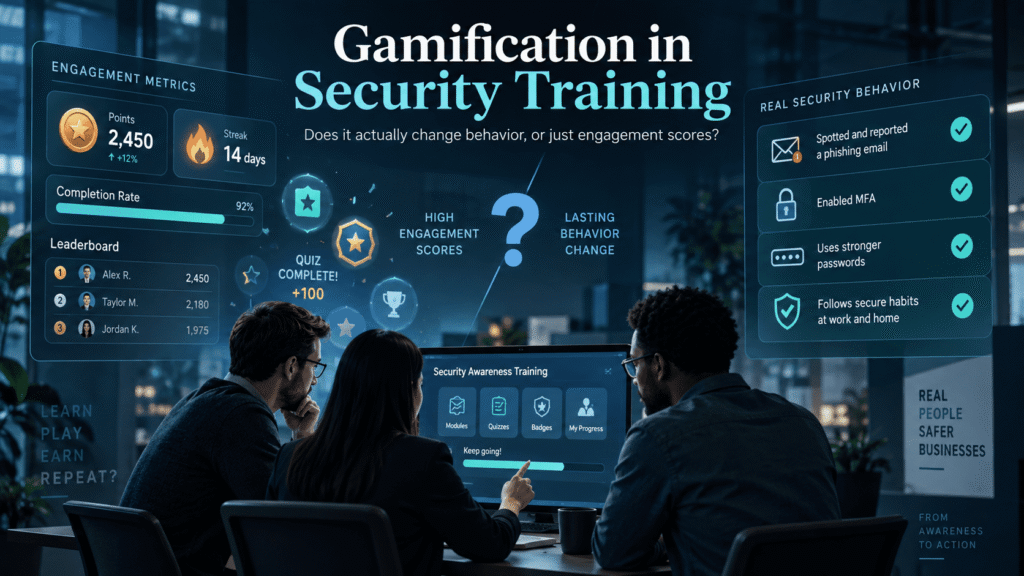
Gamification in Security Training: Does It Actually Change Behavior, or Just Engagement Scores?
Introduction
Your security awareness program has a problem. Employees click through phishing tests. They forget their passwords. They leave computers unlocked. Then someone in the C-suite asks: “Why aren’t they changing their behavior?”
The answer vendors want to sell you is gamification.
Points. Leaderboards. Badges. Achievements. The logic seems sound: if you make security training feel like a game, people will engage more. They’ll pay attention. They’ll remember the lessons. They’ll actually change how they work.
But there’s a gap between engagement and behavior change. A wide one.
Employees can have the highest engagement scores in the company and still hand over credentials to a sophisticated phishing email. They can earn every badge available and still use their dog’s name as their password. Engagement metrics look great in board reports. Actual security improvement is messier, harder to measure, and often disappointing.
This isn’t an argument against gamification. It’s an argument for understanding what it actually does, what it doesn’t, and how to use it as part of something bigger.
What Gamification Actually Is (and Isn’t)
Gamification means adding game mechanics to non-game activities. Leaderboards. Points. Achievements. Progress bars. Time limits. Competitive or cooperative challenges.
It’s not the same as game-based learning. A full security simulation game teaches through narrative and repeated decision-making. Gamification adds a scoring layer on top of traditional content.
The core idea: game mechanics tap into intrinsic motivation. We’re wired to compete, progress, and earn recognition. If you can harness those instincts, people will engage more with material they’d otherwise skip.
This works. Engagement increases. Completion rates go up. Click-through rates on training materials improve.
But engagement and learning are not the same thing. Learning and behavior change are not the same thing either.
The Engagement Problem
Here’s what I’ve seen repeatedly: security teams celebrate high engagement metrics and then wonder why their incident rate didn’t drop.
A mid-sized financial services company implemented a heavily gamified awareness program. Leaderboards. Monthly competitions. Badges for completing modules. The first month was electric. Employees were competing for top spots. Completion rates hit 95%.
Six months later, they had a successful email compromise incident. The attacker used a phishing email that looked nearly identical to a legitimate business request. The employee who fell for it had completed every training module. They’d won three badges. They scored in the top 10% of the company.
They still didn’t recognize the attack.
This is the central problem with gamification: it optimizes for the wrong thing. It optimizes for engagement with the training program, not for the underlying behavior change you actually need.
An employee can be highly engaged with leaderboard competition while treating the actual content as a checkbox exercise. They learn what will give them points, not what will keep the company secure.
When Gamification Works (and When It Doesn’t)
Gamification doesn’t fail universally. It works in specific contexts.
It works when the game mechanics align with the desired behavior. If you’re trying to increase training completion, gamification is effective. If you’re trying to maintain focus during a 20-minute module, point systems help. If you want people to report phishing attempts, making reporting competitive with recognition can drive volume.
It works when the stakes are relatively low. Playing for points in a training game is low-friction. People will optimize for it. But people don’t change fundamental behaviors based on game mechanics alone. They change behaviors when they understand the consequences or when the new behavior is easier than the old one.
It doesn’t work when the behavior is complex. Recognizing a sophisticated phishing email requires pattern recognition and critical thinking. No leaderboard will teach that. You can’t badge your way into understanding social engineering techniques.
It doesn’t work when it conflicts with actual job requirements. I’ve seen situations where the fastest way to “complete” training is to click through without reading. Gamification sometimes incentivizes exactly that. You get your points. You’re “compliant.” But you learned nothing.
It doesn’t work when employees are cynical about it. If your team sees the program as HR compliance theater, adding game mechanics doesn’t change that perception. It makes it worse.
Real Scenario: A Failed Gamification Implementation
Let me walk through an example that illustrates this clearly.
A software development company rolled out a gamified security awareness program. They had a strong technical team. They knew what they should be doing. The new program added points for completing modules, earning certifications, and winning monthly security challenges.
For three months, it worked. Engagement was high. The CISO shared the metrics in board meetings. Then a developer’s GitHub credentials were compromised through a phishing email targeting developers specifically.
The email was sophisticated. It looked like a GitHub notification about a security alert on a repository the developer was working on. It urged immediate action. The attacker’s page looked nearly identical to the real GitHub login.
The developer had completed the phishing awareness module. Twice. They’d earned the “Phishing Detective” badge. They scored high in the monthly challenges.
What they hadn’t done was slow down before clicking the link. In their actual workflow, credential requests come with urgency. GitHub notifications come frequently. They’re not used to questioning them. And a training module, no matter how engaging, doesn’t change that. Not without specific practice under realistic conditions.
The gamification program had optimized for “people clicking through training content.” It hadn’t optimized for “people pausing before entering credentials on unexpected login pages.”
The Behavior Change Question
Behavior change happens through three mechanisms: knowledge, habit, and consequence.
Knowledge alone is insufficient. You can know that clicking unknown links is risky and do it anyway. Your brain can hold two contradictory pieces of information without blinking.
Habits require repetition in context. If you never practice rejecting a phishing email under realistic conditions, you won’t reject it when it matters. Your brain defaults to the habitual response, not the learned rule.
Consequences matter more than we want to admit. People change behavior when they experience feedback. Real-world consequences work better than abstract warnings. If clicking the link gets you pwned immediately in a realistic simulation, that registers differently than an offline training module.
Gamification addresses the first mechanism partially. It can communicate knowledge in an engaging way. It can increase the likelihood people complete training. But it doesn’t create new habits. And it certainly doesn’t reproduce real-world consequences.
This is why behavior change in security is hard. You’re not trying to teach people to do something easier or more convenient. You’re trying to make them do something harder and slower. You’re asking them to introduce friction into their workflow. To pause before clicking. To question unexpected requests. To report things instead of ignoring them.
Game points don’t create that. Badges don’t either.
What Makes Security Training Actually Stick
Research from security awareness practitioners points to a few consistent factors:
Realistic scenarios work. When employees see attacks that actually match the threats your company faces, they retain more and transfer that knowledge better. Generic “Nigerian prince” examples are less effective than simulations that look like your actual business emails.
Immediate feedback works. When someone fails a phishing test, telling them immediately why it was a phishing attempt is more effective than telling them in a debrief email a week later. The brain makes stronger connections with immediate consequences.
Repeated exposure works. One training session doesn’t stick. Neither does one phishing simulation. People need to see variations on the same attack multiple times. Their neural pathways need to recognize the pattern.
Personal relevance works. A developer cares more about attacks targeting developers. An accountant cares more about invoice fraud. Generic training is easy to dismiss as not applicable.
Psychological inoculation works. When people practice recognizing and resisting attacks in a safe context, they’re more resistant to the real thing. This is why red team exercises often work better than classroom training. You’re practicing the actual decision-making under some approximation of real conditions.
Gamification can support some of these. It can make repeated exposure more engaging. It can add personal relevance through role-specific challenges. But it’s not a substitute for them.
Practical Steps for Your Team
If you’re building or evaluating a security awareness program, treat gamification as one component, not the foundation.
Start by defining actual behavior change. Not “completion rates.” Not “points earned.” Define the specific security behaviors you want. Are you trying to reduce successful phishing clicks? Improve password practices? Increase phishing reporting? Decrease social engineering success in pretexting calls? Write these down.
Design training backward from these behaviors. What do people need to know or practice to actually achieve this behavior? If you’re trying to reduce phishing clicks, people need to practice recognizing phishing emails that look like real emails they receive. If you’re trying to improve reporting, people need to know exactly how to report and see that it leads somewhere.
Incorporate realistic scenarios. Use emails that match your industry and company. Base simulations on actual threats your industry faces. This increases transfer of learning to real work.
Add immediate feedback. When someone fails a phishing test, show them why immediately. What was the indicator they missed? What should they have done? Make the connection clear in the moment.
Use gamification to drive engagement with the fundamentals. Use points and leaderboards to encourage module completion. Use badges to recognize participation in security initiatives. Use competitions to drive reporting of security issues. But don’t expect the gamification itself to change behavior.
Measure what matters. Track incidents. Track clicks on simulated phishing. Track the time from detection to reporting. These tell you about behavior change. Engagement metrics tell you about program completion. Both are useful. Don’t confuse them.
Test your program with a pilot group. Before rolling out to the whole company, see what actually changes behavior in your environment. Every company is different. What works elsewhere might not work for you.
How Gamification Fits Into a Real Security Awareness Program
The effective security awareness programs I’ve seen don’t rely on gamification alone. They layer multiple approaches.
Behavioral science gets the foundation. You understand your users. You know what motivates them. You know what they’re already doing wrong. You design around actual decision points in their day.
Realistic simulation adds the practice component. Phishing simulations that match your environment. Social engineering scenarios relevant to your company. Practical exercises, not abstract lessons.
Gamification adds engagement and motivation. It drives completion. It creates positive associations with the training. It provides recognition and friendly competition. It supports behavior change by making good security choices visible and rewarded.
Dark web monitoring creates external awareness. When employees know their company is monitoring for compromised credentials and data, that reinforces the behavior changes the training is trying to create. This isn’t game mechanics. This is real consequence. It matters.
Community and discussion make it stick. Security training that happens in isolation is less effective than security awareness that’s part of ongoing conversation. Whether that’s through security champions, team discussions, or incident post-mortems, humans internalize lessons better in social context.
Gamification is the engagement layer in this stack. It’s not the entire stack.
CruxRoot and Effective Awareness
This is where Cruxroot’s approach makes sense. The platform combines realistic phishing simulations with dark web monitoring and gamified training.
The phishing simulations create the realistic scenario component. They’re based on actual threat patterns. They provide immediate feedback. They create habit formation through repetition. That’s not gamification. That’s learning science.
The dark web monitoring adds real consequence. Knowing your credentials are being watched changes how you think about credential security. That’s behavior change through awareness, not through game mechanics.
The gamified training components then sit on top of that foundation. Points for completing modules. Recognition for strong performance on simulations. Community aspects that make security awareness visible and social. These amplify engagement with training that’s already designed to change behavior.
The combination works because gamification isn’t carrying the entire load. It’s supporting an awareness program that’s already built on solid foundations. The realistic simulations do the actual behavior-change work. The gamification makes people want to engage with it and builds momentum.
This distinction matters. If you buy a platform thinking gamification alone will fix your security posture, you’ll be disappointed. If you buy one as part of a comprehensive approach, understanding what each component actually does, you’re more likely to see improvement.
Conclusion
Gamification in security training works. Just not for what most people think.
It works for engagement. It works for motivation. It works for creating positive associations with security training. It works for driving completion rates.
It doesn’t reliably work for behavior change. Not by itself.
Behavior change comes from realistic practice, immediate feedback, repeated exposure, and understanding actual consequences. Gamification can support those. It can make them more engaging. But it can’t replace them.
If you’re evaluating a security awareness program or building one, ask the hard questions. What specific behaviors are you trying to change? What evidence shows this approach will create that change? How are you measuring the change you actually care about, not just engagement metrics?
Don’t reject gamification. Use it as one part of something bigger. Use phishing simulations that reflect real threats. Use monitoring that creates real awareness of risk. Use gamification to drive engagement with those fundamentals. Measure actual behavior change, not just game score.
That’s how security awareness moves from looking good in reports to actually reducing risk.
Check our latest the blog regarding What Your Company’s Data Worth on Dark Web