

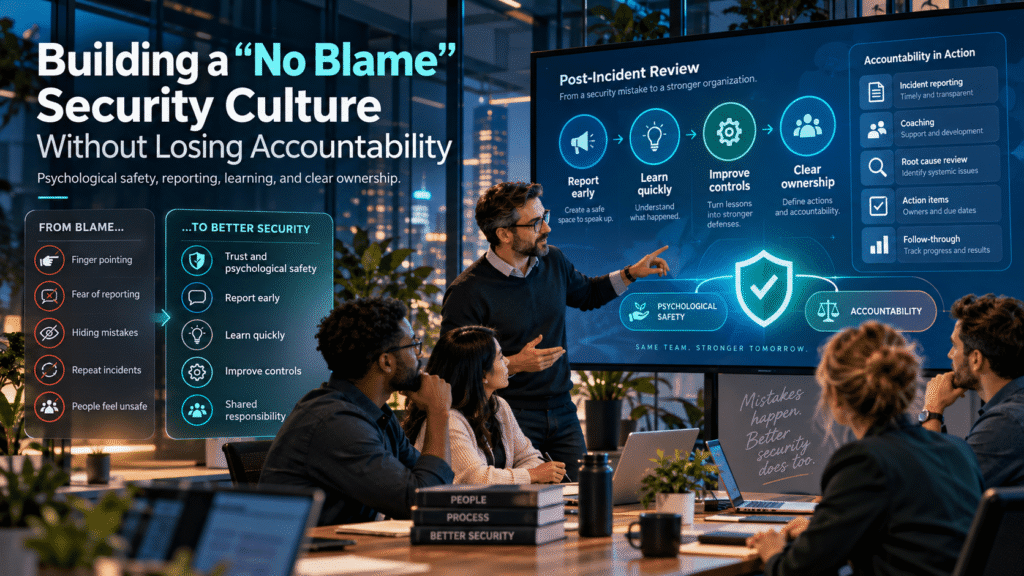
Building a “No Blame” Security Culture Without Losing Accountability
Your security team receives an alert. A developer just clicked a credential-harvesting phishing email and entered their password. Your first instinct might be to investigate who did it and when. Your second might be to send a company-wide shame email. Your third—if you’re thoughtful—is to ask a harder question: Why did this happen, and what needs to change so it doesn’t happen to someone else?
This is the central tension in modern security culture. Organizations know they need accountability. Contracts demand it. Audit frameworks expect it. Your board wants to know what controls are working. But you also know that fear-based security doesn’t work. When employees hide mistakes or avoid reporting incidents because they’re afraid of punishment, your blind spots grow. Threats stay hidden longer. Incident response suffers.
The phrase “no blame culture” sounds simple until you try to build it. What it actually means is creating an environment where people report security incidents quickly and honestly, where they own their mistakes and learn from them, but where the focus is on systems and processes rather than individual punishment. That’s not soft. That’s smart.
Why “No Blame” Doesn’t Mean “No Consequences”
A “no blame” culture is often misunderstood as permissive or weak. It’s neither. The goal isn’t to ignore what happened. The goal is to understand it deeply enough that you fix the root cause.
Consider this: An employee receives a convincing phishing email. It looks like a message from their bank. They click the link. A few hours later, your security tools flag unusual activity on their account. What happens next defines your culture.
In a purely punitive environment, the employee gets written up. Maybe they’re removed from sensitive projects. Other employees learn a lesson from this public example—namely, to hide similar mistakes. They won’t report the next phishing email they almost fell for because they’re afraid of the same treatment. Your visibility into threats shrinks.
In a truly “no blame” environment, there’s no investigation into why this specific person fell for it. That’s wrong too. You need to understand what actually happened. But the conversation centers on systems and prevention, not discipline.
The employee reports it. Your team investigates the email, the infrastructure that allowed it to reach employees, the training gaps it revealed, and whether your phishing simulation program covered similar scenarios. If there are behavioral patterns—someone clicking links they never verify, ignoring security controls repeatedly—that’s when individual accountability enters the picture. But it’s accountability for change, not accountability for punishment.
This distinction matters. It’s the difference between a security culture that’s built on honesty and one that’s built on fear.
The Human Side of Security Culture
Security problems are ultimately people problems. You can deploy the best technology in the world, but if your employees don’t report incidents or follow security practices, you’re flying blind.
Research in organizational behavior has consistently shown that people in high-fear environments hide problems. They don’t report mistakes. They don’t ask for help when they’re unsure. They look for ways to avoid visibility rather than ways to stay secure. This is true in aviation, healthcare, manufacturing, and software development. It’s also true in security.
The opposite environment—where people feel psychologically safe—produces faster incident detection, more complete incident reports, and better long-term behavioral change. People are willing to say “I wasn’t sure about that request and I blocked it” rather than second-guessing themselves and letting something through.
But psychological safety doesn’t come from absence of standards. It comes from clarity about what those standards are and confidence that mistakes will be treated as learning opportunities rather than career-ending events.
A developer who clicks a phishing link made an error. That error is worth understanding. It’s not worth destroying someone’s career over. A person who repeatedly ignores security protocols, even after training, is a different problem. That might require discipline or retraining or role changes. But that’s accountability based on patterns, not on a single incident.
What Actually Changes Behavior
If your goal is a culture where people follow security practices, you need to understand what actually motivates behavior change.
Punishment works temporarily. People avoid the behavior they were punished for, often by hiding it better. Fear is a good short-term motivator and a terrible long-term one. Over months and years, people either become numb to it or they leave.
What actually changes behavior over time is a combination of three things. First, people need to understand why the behavior matters. This isn’t abstract. It’s personal. “This is why you shouldn’t click suspicious links. Here’s how an attacker could use access to your account. Here’s what happened to someone at a company like ours.” Second, they need to practice the right behavior in low-stakes situations. This is where phishing simulations and security exercises live. Third, they need to see consistent feedback and reinforcement over time.
In practical terms, this means your security training can’t be a once-a-year compliance checkbox. It needs to be regular, relevant, and tied to real incidents in your environment. Phishing simulations work because they’re low-stakes practice of a real threat. Employees get the feedback immediately. The best ones include light training at the moment of failure—when the employee is most receptive—rather than a generic annual course.
The behavioral science is clear. Punishment-based security training produces compliance through fear. Training combined with regular, low-stakes practice produces genuine behavior change.
Building the System, Not Just the Culture
Culture doesn’t exist in the abstract. It’s built through systems, processes, and repeated decisions.
If you want a “no blame” culture, you need incident response processes that are designed to gather information, not assign blame. This means your first response to any security incident shouldn’t be “who did this,” but “what happened and why.” It means your incident report templates ask about timeline and context, not about who needs to be fired.
It means your security training is ongoing, not punitive. New hire onboarding should include practical security training, not just policy documents. Regular phishing simulations should be part of normal business operations, not a test that only happens when there’s been a breach. Security should be woven into how people work, not treated as something done to them.
It means your tools give you visibility into the metrics that actually matter. How many phishing emails are employees reporting? How many are they clicking? What’s the time between when an unusual account activity happens and when it’s reported? Are your training messages landing with the groups most likely to fall for attacks? Without this data, you’re operating on assumptions.
It also means clear communication about what accountability actually means in your organization. If someone clicks a phishing link once, they get training. If someone repeatedly ignores access control policies despite training, there’s a conversation about fit for role. If someone tries to cover up a security incident or bypass controls intentionally, that’s different from falling for a well-crafted attack. Make these distinctions explicit.
A Real Scenario: How This Actually Works
Let’s ground this in reality. Your company is a 150-person SaaS organization. You use email and cloud infrastructure. Your finance team processes payments and invoices. Your engineering team has production access.
Your CFO receives an email that looks like it’s from your CEO. It asks for immediate wire transfer authorization for an urgent acquisition. The email address is close to real but slightly off: “[email protected]” instead of “[email protected].” The CFO’s email client doesn’t flag it as suspicious.
The CFO forwards it to your accounting team with a note to process it. Before they do, your accounting manager does something unusual. She calls the CEO’s assistant to confirm. The acquisition is real, but the amount is wrong. They never send wires via email. There’s a process for it.
In a fear-based security culture, this might never happen. The accounting manager might not want to second-guess the CFO or look like she doesn’t trust the CEO. She might just process the request. Or she might be so afraid of missing a critical business deadline that she doesn’t take the time to verify.
But in your organization, security is built into the process, not added on top. All wire transfers go through an approval process in your financial system. Email alone can’t authorize them. And your team knows that questioning a suspicious request is a good thing.
Your accounting manager reports the email to your security team. Your team investigates. The CEO’s email credentials aren’t compromised. The CFO’s email is. This becomes the starting point for your response.
Here’s where no-blame culture meets accountability. You don’t suspend the CFO. You investigate how their email was compromised. Was it a phishing attack? A password reuse incident? Did they use the same password on an unrelated service that was breached? Each answer points to different controls.
Your security training identifies that executive-level spear phishing is a real threat in your industry. You add simulation campaigns targeting executives with realistic scenarios. You provide specific training on this attack pattern. You might implement additional controls like requiring phone verification for certain types of transfers, but only if the operational impact is worth the security gain.
The CFO participates in the training because it’s framed as “this is a targeted attack in our industry” not “you were stupid.” They’re more likely to be receptive. They’re more likely to learn.
Was there a failure? Yes. Did something need to change? Yes. Did the CFO need to be publicly humiliated or fired? No. The culture that resulted was stronger because people saw that mistakes were treated as learning opportunities, not career-enders.
Practical Steps to Build This
If you’re starting to think about this in your organization, here’s what actually needs to happen.
Start with your incident response process. Review it with your team. Does it ask “who did this” first or “what happened and why” first? Change the questions. Does it distinguish between accidental clicks and intentional policy violations? Add that distinction. Does it include a learning phase or just a disciplinary phase? Add one.
Second, assess your current training program. Is it annual compliance theater, or is it ongoing? If it’s theater, that’s your starting point for change. Adding regular phishing simulations costs less than you think and catches issues annual training misses entirely.
Third, be explicit about accountability. Write down what happens in different scenarios. First phishing click: training and follow-up. Second click within six months: targeted training. Repeated violations despite training: conversation with the person and their manager. Intentional bypass of controls: disciplinary process. This clarity removes the fear of arbitrary punishment and gives people concrete expectations.
Fourth, measure the behaviors that matter. How many incidents are being reported by employees? How many phishing emails are making it to inboxes? What percentage of employees click on simulated phishing campaigns, and is it trending down? What’s the time from incident to report? If you can’t see these metrics, you can’t manage them.
Fifth, communicate why this matters. People respond better when they understand the purpose behind security practices. Tie security directly to business impact. “We had a financial fraud attempt last quarter that we caught because of our processes. Here’s how that process worked.” Make it real and relevant.
Finally, be consistent. Culture doesn’t shift because you send one email or run one training. It shifts through repeated decisions that reinforce the same message. Every time someone reports an incident and it’s treated as a learning opportunity rather than punishment, the culture gets stronger.
Tools and Approaches That Support This Culture
Technology alone won’t build a security culture, but the right tools make it possible.
Phishing simulation platforms let you identify vulnerable employees and provide immediate training at the moment they click. The data shows you which teams need more support. The tracking shows you trends over time. And done right, the simulations feel like real attacks, providing practice in low-stakes conditions.
Dark web monitoring tools help you understand when your organization’s credentials appear in breached databases. This gives you early warning of compromises and a clear, non-punitive way to respond. You find out your CFO’s credentials are being sold online. You don’t fire the CFO. You help them change their password, check for damage, and understand how to prevent reuse.
Gamified training platforms work because they meet people where they are. Security training often feels like punishment. Gamification doesn’t make it fun exactly, but it makes it engaging. Points, leaderboards, and immediate feedback keep people more engaged than annual video modules followed by a test.
The key to all of these tools is how you use them. They can support a punitive culture or a learning culture depending on how you frame the results. When a department has high phishing click rates, do you shame them or provide targeted training? That choice defines your culture.
The Role of Cruxroot in This Approach
This is where platforms like Cruxroot become relevant. Building a no-blame, accountability-focused security culture requires understanding what’s actually happening in your environment and providing regular, targeted intervention.
Cruxroot provides the phishing simulation campaigns that give employees practice in real-threat scenarios. Instead of annual training, you get ongoing exposure to the types of attacks that actually target your industry. Employees see targeted simulations that look like threats they might face, get immediate feedback when they fail, and receive training when they’re most receptive.
The platform’s gamification features support behavior change through engagement rather than fear. Employees track their progress, see team rankings, and participate in friendly competition around security awareness. This works because humans respond to clear, immediate feedback about progress. You’re not shaming anyone. You’re giving them visibility into their own improvement.
Dark web monitoring gives you the visibility you need to respond to compromises proactively. When credentials appear in breached databases, you know immediately. You can reach out to the affected person with actionable steps, not with blame. This early warning prevents actual incidents and reinforces that your security program is built to help people, not catch them.
The reporting and metrics dashboards let you see what’s actually happening. Which teams are most vulnerable? Which simulations are most effective? What’s the impact of your training over time? This data drives decisions about where to focus your security efforts, moving from gut feeling to evidence.
Accountability Without Blame
To wrap this up, building a security culture that works requires understanding a fundamental truth: people who feel safe report problems faster and more honestly. People who fear punishment hide them.
This isn’t soft management. It’s strategic. Your security program will catch more threats, respond faster, and prevent more damage if people trust it. That trust comes from being treated as capable professionals who will learn from mistakes, not as sources of risk to be controlled through fear.
Accountability still matters. Patterns of negligent behavior, intentional policy violations, and attempts to cover up incidents need clear consequences. But isolated mistakes, especially when caught through your early warning systems, are opportunities for improvement.
The organizations that win at security over the long term are the ones that get this balance right. They have clear processes, regular training, good tools, and consistent leadership messaging that reinforces this approach. It’s not weaker. It’s smarter.
Check our latest the blog regarding Credential Stuffing Explained How One Leaked Password Reset Can Cascade