

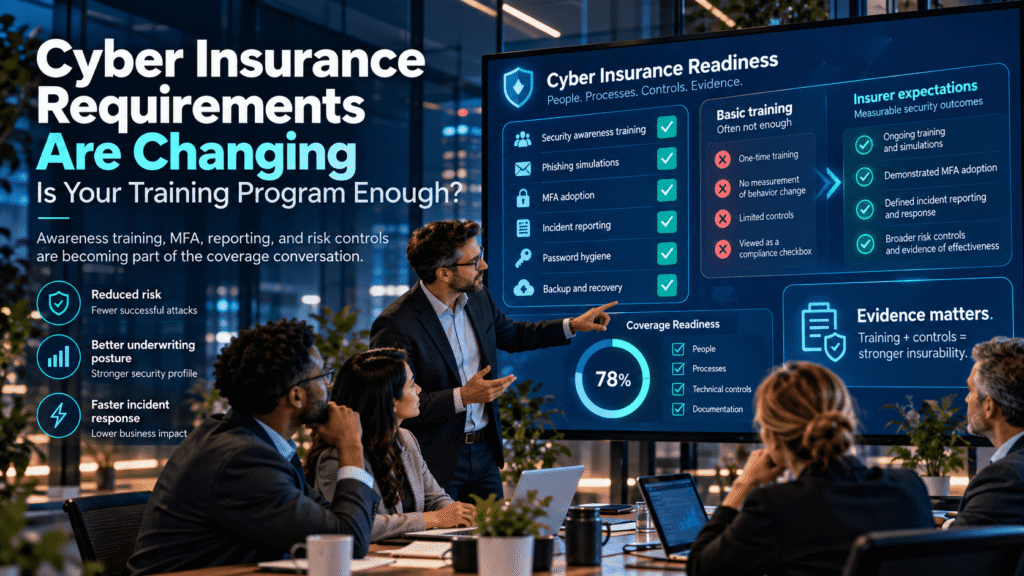
Cyber Insurance Requirements Are Changing: Is Your Training Program Enough?
If you’ve renewed a cyber liability policy in the last year, you’ve probably noticed the questions are different now. Insurers aren’t just asking whether you have a training program. They’re asking how you measure it, what happens when someone fails, and whether you can prove that training actually changes employee behavior.
This shift isn’t coming from nowhere. Insurers have paid out billions on claims where the root cause traces back to a compromised employee account or a successful phishing attack. They’ve learned that generic awareness training doesn’t reduce risk the way security leaders hope it does. The result is a new baseline of expectations that’s catching many organizations flat-footed.
Your training program might meet yesterday’s requirements. It probably doesn’t meet today’s.
The Insurance Landscape Has Shifted
For years, the cyber insurance application process was straightforward. You checked boxes. You had an annual awareness training program. You passed. Your premium reflected your industry, revenue, and a few other basic factors.
That’s no longer how it works.
Insurers now conduct deeper reviews of your security posture before deciding whether to cover you. More importantly, they’re pricing risk based on what they find. A company that runs a checkbox training program will pay a different rate than one that can demonstrate measurable behavioral change and active threat response.
The driver is simple economics. Claims data shows that employee behavior is the variable that matters most. A company can have excellent network segmentation, but if an employee hands credentials to an attacker, that doesn’t matter. The breach happens anyway.
Insurers have also tightened their definitions of what counts as a covered loss. Many policies now exclude losses that result from preventable social engineering attacks if the organization can’t demonstrate that security awareness training met certain standards. In some cases, that means a ransomware infection triggered by a phishing email becomes a non-covered event.
For security teams, this creates urgency. It’s not just about reducing risk anymore. It’s about proving that you’re reducing risk in ways that meet insurance requirements.
What Insurers Actually Want to See Now
The vague requirement used to be “annual security awareness training.” Most organizations interpreted this as one 30-minute video that employees watched once a year while checking email.
Insurers now want evidence that your training program actually works. Specifically, they’re looking for these elements:
Measurable phishing susceptibility data. This is the new standard. Insurers want to see that you’re running simulated phishing campaigns and tracking employee click-through and reporting rates. They’re interested in the baseline, the trend over time, and how you respond to high-risk employees. A company that can say “our click rate dropped from 15% to 4% over 18 months” has defensible proof that training is having an effect. A company that says “we do annual training” has nothing.
Frequency and relevance. One training session per year is now considered insufficient. Insurers expect ongoing training that’s adapted to emerging threats. If you’re training everyone on the same topics from 2021, that’s a problem. Insurers want to see that your program reflects the current threat landscape.
Role-based content. Generic training for everyone doesn’t convince insurers. They want to see that you’re tailoring content to different job functions. Finance staff face different threats than IT staff. Executives are targeted differently than support staff. Insurers expect your training to reflect those realities.
Response procedures. Training is only half the story. Insurers want to know what happens when someone reports a phishing email or falls for an attack. Is there a clear process? Are security incidents tracked? Is there follow-up training for repeat offenders? A training program that doesn’t tie into incident response looks like security theater.
Documentation and audit trails. Insurers now ask for proof. They want records showing who completed training, when, and what they learned. They want metrics. They want evidence that the program is being actively managed, not just implemented and forgotten.
Integration with incident response. The best training programs learn from real incidents. When your organization experiences a breach or near-miss, the security team should be updating training to address the specific vulnerability that was exploited. Insurers want to see this loop.
This isn’t just about policy language anymore. Insurers are asking these questions before they issue policies, and they’re basing premiums on the answers.
Why Traditional Training Fails the Audit
Most organizations still rely on what could be called “legacy awareness training.” It typically looks like this: a learning management system (LMS) contract, usually with a vendor whose training was created five years ago. Annual mandatory enrollment. Completion by the deadline. Checkbox cleared.
The problem is that checking a box and changing behavior are not the same thing.
Compliance-focused training works for demonstrating that you did something. It doesn’t work for actually reducing risk. Employees complete a 20-minute video about phishing because they have to, not because they’re engaged. They forget 80% of it within two weeks. When an actual phishing email arrives, they don’t apply what they learned because it didn’t stick.
Worse, traditional training often fails the specificity test that insurers now apply. Generic content about “suspicious emails” doesn’t prepare an employee for the actual phishing emails their organization receives. A Finance team member needs to know what a fake invoice looks like. An HR recruiter needs to understand how business email compromise works in a hiring context. A system administrator needs to know how their privileged access makes them a target.
One more issue: traditional training doesn’t test whether employees actually learned anything. You complete the course, you get a certificate, you’re done. There’s no measurement of retention or behavioral change. This is exactly what insurers say they can’t accept anymore.
The result is that many organizations discover during insurance renewal that their training program, while compliant with their own internal policies, doesn’t meet insurer expectations. Renewal conversations become uncomfortable. Premiums increase. In some cases, insurers decline to renew unless the training program is overhauled.
A Real Example: The Mismatch at a Mid-Market Tech Company
Consider a software company with 250 employees across two offices. They’ve been with the same cyber insurance carrier for three years. Their annual training program consists of a single 45-minute video on password security and phishing awareness, distributed in September. Completion is mandatory. The company tracks completion rates in their LMS.
The company’s security team knows this isn’t ideal, but resources are limited. They’re focused on maintaining their network, managing vendors, and responding to occasional security incidents. Training feels like a checkbox.
During renewal, the insurance broker asks a series of detailed questions. Does the company run phishing simulations? No. Do they track employee response rates? No. Is training role-specific? No. Do they have metrics showing training effectiveness? No. Have they updated the training content in the last year? No. What’s the incident response procedure when someone falls for a phishing email? It exists, but it’s not connected to training.
The insurer’s risk assessment comes back with a higher premium. The company is also placed in a category that excludes social engineering losses under certain conditions. The broker explains that to get back to the previous rate and remove the exclusion, the company needs to demonstrate a measurable training program with phishing simulations and documented behavior change.
The company now has a choice. They can accept the higher premium and the coverage gap, or they can invest in a more robust training program. Most choose the latter, but the process takes months. It costs money. And it should have happened long before the renewal conversation.
This scenario is playing out across industries right now.
What Insurers Are Seeing in Claims
The data backing this shift in insurance requirements is clear to anyone who manages claims. A significant percentage of successful attacks begin with compromised employee credentials obtained through phishing or social engineering.
When an insurer investigates a breach claim, they don’t just look at the technical controls. They look at the human layer. Did the employee receive training on recognizing phishing? Did they know how to report suspicious emails? Was there a process in place to quarantine and analyze the email they clicked?
If the answer to those questions is “sort of” or “we’re not sure,” the insurer’s position weakens. They start asking whether the loss was foreseeable and preventable. They review the policy language carefully to see whether the claim falls under an exclusion.
None of this is adversarial in spirit. Insurers want to pay claims when the insured has done what a reasonable security organization would do. The problem is that “doing what a reasonable organization would do” has changed. It now includes demonstrating that training is effective and integrated into the broader security program.
What Your Training Program Actually Needs
If your organization is serious about meeting current insurance requirements and reducing actual risk, here’s what a functional training program looks like:
Start with measurement, not compliance. Before you choose training content or schedule sessions, decide what you’re actually measuring. For most organizations, the starting point is phishing susceptibility. Run a baseline phishing simulation to see how many employees click, report, or ignore the email. That number is your starting point. The goal is not to reach zero clicks. The goal is to show trend improvement over time.
Make training ongoing, not annual. One training session per year doesn’t work. Quarterly training tied to emerging threats is better. Monthly training is better still. The frequency sends a signal that security is a continuous priority, not a once-a-year checkbox.
Build role-specific content. Don’t treat your Finance team the same as your IT staff. Create training tracks for different job functions. The content for executives should emphasize business email compromise and credential theft. For Finance, emphasize invoice fraud and wire fraud. For IT, emphasize lateral movement and privilege abuse. For everyone, include general phishing awareness, but make it specific to your industry and your organization’s threat landscape.
Tie training to simulation results. Don’t run phishing simulations and then run training on a separate track. Use the simulation data to drive training. If your latest simulation showed that 12% of employees clicked a fake invoice, run targeted training on invoice fraud. If 5% entered credentials in a fake login page, train on credential security. This approach makes training feel relevant because it addresses real vulnerabilities in your organization.
Create a reporting and escalation process. Employees should know exactly what to do when they receive a suspicious email. A clear process reduces anxiety and increases reporting rates. When someone reports a phishing email, have someone review it, analyze it, and send organization-wide lessons learned if it’s a new attack pattern. This trains the entire organization through real incidents.
Track everything. Which employees completed training and when? What was the click rate on the last phishing simulation? How many employees reported the follow-up test? How many legitimate security incidents were reported by employees? These metrics should be reviewed regularly and reported to leadership.
Update content based on incidents. When a breach or near-miss occurs, use it as a training moment. If someone was tricked by business email compromise, develop training on that specific attack. If a system was accessed from an unusual location, train on unusual access patterns and when to challenge them. Your training program should evolve based on what you learn.
Include consequences and reinforcement. Employees who repeatedly fall for phishing simulations should receive additional training, not just a warning. Make it clear that the training is meant to help, not punish, but take it seriously.
The Practical Steps: A Checklist
Here’s a concrete starting point for reviewing and improving your training program:
- Assess current state. Document what training you currently have in place. When was it created? How often is it required? Who completes it? How do you measure results? Be honest about gaps.
- Define your metrics. Decide what you’ll measure. Start with phishing click rates. Add reporting rates if possible. Add completion rates. You need numbers.
- Choose a phishing platform. If you’re not running simulations, start. There are many options at different price points. Pick one and commit to running tests at least quarterly.
- Run a baseline simulation. Don’t share results yet. Just get the data so you know where you stand.
- Develop role-based content. Work with your business units to understand the most common threats they face. Create training that addresses those threats.
- Schedule ongoing training. Aim for at least quarterly. Tie it to simulation results when possible.
- Create a reporting process. Define how employees report suspicious emails. Make sure the process is simple and widely communicated.
- Review and update policies. Check your incident response procedures, your email security policies, and your account access policies. Make sure they reflect current threats and support your training goals.
- Get leadership buy-in. Security training is most effective when leadership treats it seriously. Make sure executives are aware of the program and the results.
- Document everything. Keep records of training completion, simulation results, and metrics. This is what insurers want to see during renewal.
- Measure impact over time. After a few quarters, you should start seeing trend data. Are click rates going down? Are more employees reporting? Is the time to report decreasing? These trends demonstrate that training is working.
- Communicate results to your organization. People are more likely to engage with security if they see progress. Share what’s improving and why it matters.
The effort required depends on your organization’s size and current state. But the basic framework is the same across organizations.
Integration with Your Broader Security Program
Training doesn’t exist in isolation. It works best when it’s connected to other security practices.
Your email security tools should work with your training program. If you have advanced phishing detection, it should flag and quarantine the emails that employees would typically fall for, reducing the chance that a click results in a breach. But you still need training because not all phishing reaches email security tools.
Your incident response process should feed back into training. When an attack succeeds, your incident response team should understand how it happened and why. That analysis informs what you train on next.
Your access control policies affect training outcomes. If a Finance employee’s account is compromised, the damage is limited if their access is properly scoped. Training on credential security matters more when paired with policies that limit what credentials can access.
Your dark web monitoring program feeds into awareness training. If an account associated with your organization is compromised and credentials appear on the dark web, that’s a training moment. Employees need to understand that their personal account security matters because it can affect the organization.
Training is most effective as part of a coordinated security program where each component reinforces the others.
What Meeting Insurance Requirements Looks Like
When you’re ready for your next insurance renewal, you should be able to answer these questions with confidence:
How often does your organization run phishing simulations? (Expected answer: at least quarterly, ideally more frequently)
What percentage of your employees click on simulated phishing emails? (Expected answer: a declining percentage over time)
What’s your employee phishing report rate? (Expected answer: a percentage that’s higher than your click rate and trending upward)
How frequently do you conduct security awareness training? (Expected answer: ongoing, at least quarterly, not just annual)
Is your training role-specific? (Expected answer: yes, with different content for different business functions)
How do you measure training effectiveness? (Expected answer: through phishing simulation results, completion metrics, and incident data)
What happens when an employee falls for a phishing simulation? (Expected answer: additional training and follow-up, with a clear process)
How do you ensure your training stays current? (Expected answer: regular content updates based on emerging threats and internal incidents)
If your answers to these questions show a mature program with measurable results, your insurance conversation will be very different from the one your industry peers are having. You’ll have leverage. Your insurer will see you as lower-risk. Your premium will reflect that.
How Cruxroot Fits Into This Picture
Most organizations need help implementing this type of program. Security teams are usually small and stretched thin. Off-the-shelf training software exists, but choosing and configuring it can be overwhelming. Phishing simulation tools require ongoing management.
This is where platforms built specifically for modern security awareness come in. Cruxroot combines several of the elements we’ve discussed into one integrated system.
Phishing simulations are built in. You can run campaigns that match your organization’s threat landscape and industry. The platform tracks which employees click, report, or ignore simulated attacks. That data becomes the foundation for measuring program effectiveness.
The training component includes libraries of role-specific content that can be deployed based on simulation results. If your latest campaign shows weak points in a particular area, you can quickly deploy targeted training to address it.
Dark web monitoring integrates into the platform. If credentials associated with your organization show up on the dark web, that’s a trigger for relevant training and for account security reviews.
The gamification element makes the program more engaging than traditional compliance training. Employees compete on leaderboards, earn badges, and see their own progress. That engagement translates to higher participation rates and better knowledge retention.
The reporting dashboard shows exactly what insurers want to see: completion rates, simulation metrics, trend data, and evidence of an active program.
The platform doesn’t do the security work for you. You still need to define your organization’s specific security policies, respond to incidents, and manage your technical controls. But it makes it much easier to implement the employee awareness and training components that insurance companies now expect, while also reducing actual risk.
For organizations serious about meeting new insurance requirements and improving security posture, an integrated awareness platform like Cruxroot removes the friction of building this program from scratch using disconnected tools.
Conclusion
The shift in cyber insurance requirements isn’t theoretical. It’s happening now, during renewals. Organizations that have built mature training and awareness programs with measurable results are keeping their premiums stable or even getting them reduced. Organizations that are still checking boxes on annual training are paying the price.
The good news is that improving your training program has value beyond insurance. Reducing the number of employees who click on phishing emails directly reduces your risk of a successful attack. Creating a culture where security reporting is normal makes you aware of threats sooner. Building role-specific training makes your people better equipped to recognize attacks that are actually relevant to their work.
The process takes time. It requires ongoing effort. But the payoff is real: lower insurance costs, reduced breach risk, and an organization where security is a shared responsibility rather than something IT forces on everyone once a year.
Your current training program probably worked fine in 2020. It doesn’t work in 2026. The sooner you upgrade it, the better your next insurance conversation will go.
Check our latest the blog regarding Building a “No Blame” Security Culture Without Losing Accountability