

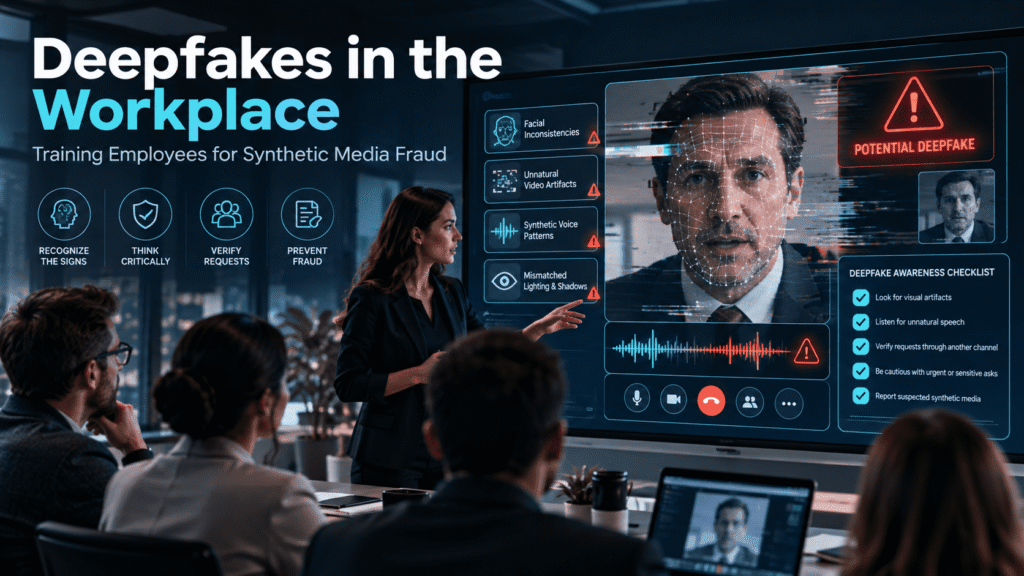
Deepfakes in the Workplace: Training Employees for Synthetic Media Fraud
Deepfakes in the workplace are no longer a conference-talk curiosity. Attackers now clone voices, fake video calls, and impersonate executives well enough to move real money. Training employees for synthetic media fraud has become a practical security requirement, not a future concern.
This post explains how these attacks work, why they succeed, and what your team can do about them. It focuses on process and behavior, because detection technology alone will not save you. People make the final call, and people need preparation.
What Synthetic Media Fraud Actually Looks Like
Synthetic media fraud uses AI-generated or AI-altered audio, video, or images to deceive someone into taking an action. That action is usually a payment, a data release, or a credential reset.
Most attacks fall into a few categories. Voice cloning is the most common because it needs the least material. A few minutes of a person speaking, pulled from a conference talk, a podcast, or a recorded webinar, can be enough to produce a convincing imitation.
Video deepfakes are harder to pull off but more persuasive when they work. Attackers can run a face swap during a live call, or play a pre-rendered clip of a “manager” giving instructions. Quality varies widely. Some fakes are poor. Some are good enough to pass a quick look on a small screen.
Then there are blended attacks. A fake voice message follows a spoofed email. A forged video clip backs up a fraudulent invoice. The synthetic element rarely works alone. It adds credibility to a story the attacker has already built.
Why Deepfake Attacks Work on Smart People
Smart, careful employees fall for these attacks. That is not a character flaw. It is how human trust works.
We recognize colleagues by voice and face, and we rarely question either. When the CFO calls and sounds like the CFO, the brain accepts it. Deepfakes exploit that shortcut directly.
Attackers also lean on the same pressure tactics that make ordinary phishing effective. They create urgency. They invoke authority. They ask for secrecy. A request that says “this acquisition is confidential, do not discuss it with anyone” is designed to stop you from verifying it.
Timing matters too. Attackers favor moments when verification is hard: late Friday afternoons, executive travel days, month-end closing, and holiday weeks. A finance employee under deadline pressure has less patience for double-checking.
The technology lowers the cost of the attack, but the psychology is old. Deepfakes are social engineering with a better costume.
A Realistic Scenario: The Urgent Supplier Payment
Consider a mid-sized manufacturing firm. An accounts payable specialist, call her Elif, receives a Teams message from the finance director on a Thursday afternoon. The director is traveling and asks Elif to join a quick call.
On the call, the director’s face appears on screen, slightly soft and a little low-resolution. The connection seems poor, which he mentions himself. He explains that a long-standing supplier has changed banks. A large payment is due today. If it misses the cutoff, production at the supplier’s plant will stall.
He asks Elif to update the supplier’s bank details and release the payment. He adds that the CEO is aware, and that she should not wait for the usual approval chain because of the time difference.
Every element of that call is built to short-circuit process. The poor video quality explains any visual glitches. The travel story explains the unusual channel. The mention of the CEO adds authority. The deadline adds pressure.
Elif follows the instruction. The payment goes out. Two days later, the real supplier calls to ask where their money is.
Nothing in this scenario required advanced hacking. The attacker needed a compromised or spoofed messaging account, some public footage of the director, and a convincing story. The failure was not Elif’s alone. The company’s process allowed a single phone call to override a control.
Notice what would have stopped it: a rule that bank detail changes require callback verification to a known number, regardless of who asks and how senior they are. That rule costs five minutes. The missing rule cost the company a six-figure loss.
The Warning Signs Employees Can Learn to Spot
Technical tells exist, but they are unreliable. Fakes improve constantly, and a clean-looking video proves nothing. Employees should know the visual and audio cues, but they should not rely on them.
Common signs of synthetic video include:
- Unnatural blinking or odd eye movement
- Lip movements that drift out of sync with speech
- Blurring or flickering around the hairline, jaw, or ears
- Lighting on the face that does not match the background
- Odd behavior when the person turns their head or raises a hand
Common signs of cloned audio include:
- Flat or unusual emotional tone
- Strange pacing, with unnatural pauses or rhythm
- Missing background noise, or noise that cuts in and out
- Repeated phrases or slightly robotic word endings
Behavioral signs are more dependable than technical ones. Teach employees to treat these as red flags regardless of how real the person looks or sounds:
- A request that bypasses normal approval steps
- Pressure to act within minutes
- A demand for secrecy
- A switch to an unfamiliar channel or personal number
- A change to payment details or access rights
- A reason the person cannot be reached any other way
The behavioral pattern is the real detection method. A perfect fake asking for something unusual should still trigger a verification step.
Why Detection Tools Are Not Enough
Vendors sell deepfake detection software, and some of it is useful. None of it is a guarantee.
Detection is an arms race. Generators improve, detectors catch up, and the cycle repeats. A tool that flags yesterday’s fakes may miss today’s. Relying on it as your only control creates false confidence, which is worse than no control at all.
There is also a coverage problem. Most attacks happen on channels you do not fully control: a personal phone, a messaging app, a call from an unknown number. No tool inspects every one of those.
Treat detection software as one layer. Use it where it fits, such as screening recorded media or flagging anomalies in video meetings. But build your defense around verification procedures that work even when the fake is flawless.
Build Verification Into the Process
The strongest defense against synthetic media fraud is a rule that does not depend on anyone’s ability to judge authenticity. If a request is sensitive, verify it through a second channel. Always.
Here is what that looks like in practice.
Use out-of-band verification. If someone requests a payment, credential, or data release by voice or video, confirm through a different channel. Call back on a number already in your records. Do not use a number the requester gives you.
Set approval thresholds. Payments above a defined amount require two approvers. Bank detail changes require a callback and a written ticket. No single person can override these, including executives.
Use a shared challenge phrase. Some organizations agree on a code word or question that executives and finance staff can use to confirm identity. Keep it offline and change it regularly. It will not suit every team, but it works well for small, high-risk groups.
Slow down on purpose. Make it normal, even expected, to say “I will confirm and call you back.” If employees fear looking obstructive, they will skip the step. Leadership must reinforce that verification is respected, not resented.
Protect the exceptions. Attackers target the “urgent exception” because that is where controls are weakest. Define exactly how a real emergency gets handled, so no one has to improvise under pressure.
Reduce What Attackers Can Collect
Deepfakes need source material. You cannot erase your public footprint, but you can reduce easy pickings.
Review how much executive audio and video sits in public places. Conference recordings, earnings calls, podcast appearances, and social media clips all feed voice and face models. You do not need to hide your leaders, but you should know what exists.
Pay attention to organizational information as well. Attackers need names, reporting lines, vendor relationships, and project details to build believable stories. Org charts on public websites, detailed LinkedIn profiles, and oversharing in press releases all help them.
Credential exposure matters here too. A compromised email or messaging account lets an attacker send a fake request from a real address. That makes the deepfake far more convincing. Knowing when employee credentials appear in breach data lets you reset them before attackers use them.
What Security Teams Can Do This Quarter
Policy documents do not stop fraud. Practiced habits do. Here is a practical checklist your security team can start on now.
- Map your high-risk workflows. List every process where a voice or video request can trigger money movement, access changes, or data release. Finance, HR, IT help desk, and executive assistants usually top the list.
- Add callback verification to those workflows. Write it down, publish it, and make it mandatory.
- Brief your executives. They are the most impersonated people in the company. Explain why their voices and faces are targets, and ask them to support verification rules publicly.
- Update your incident response plan. Include a path for reporting suspected synthetic media. Employees should know exactly who to call and what to preserve.
- Run tabletop exercises. Walk finance and leadership through a deepfake scenario. Find the gaps before an attacker does.
- Harden the help desk. Voice-based password reset requests are a favorite target. Require identity verification steps that do not rely on recognizing a voice.
- Include synthetic media in awareness training. Show real examples. Let employees hear a cloned voice, in a safe setting, so they understand how convincing it can be.
- Measure behavior, not attendance. Track how often employees report suspicious requests and how often they follow verification steps. Completion rates tell you little.
Start with the first two items. Even a modest improvement in verification discipline closes the largest gap.
Training Employees to Respond, Not Just Recognize
Awareness alone does not change behavior. An employee who knows deepfakes exist may still comply when the CEO “calls” and demands action. Training must build a response habit.
Good training does several things. It shows realistic examples. It explains the psychology of pressure and authority. And it gives people a simple script they can use in the moment: “I need to verify this through our standard process. I will call you back in five minutes.”
That script matters. Many employees freeze because they do not know how to push back politely. Give them the words.
Repetition matters too. A single annual session fades quickly. Short, frequent exercises keep the behavior fresh and make verification feel routine. Simulation works especially well, because employees practice under realistic conditions without real consequences.
Tailor the content to the audience. A finance team needs payment-fraud scenarios. The help desk needs account recovery scenarios. Executives need to understand how their own likeness can be used against the company. One generic course will not cover all of these.
Finally, make reporting easy and blame-free. If an employee almost fell for a fake call, you want to hear about it immediately. Punishing near-misses teaches people to stay quiet.
Where Cruxroot Fits In
Deepfake fraud is a human problem with a technical accelerant. Cruxroot approaches it from the human side, supporting the habits described above.
Phishing simulations let you test how employees respond to realistic social engineering, including pretexting, urgent requests, and impersonation of senior staff. You see who verifies and who complies, and you can target follow-up training where it matters. Simulations build the pause-and-verify reflex that stops synthetic media attacks, whatever format they take.
Dark web monitoring addresses the data side. When employee credentials or corporate details surface in breach data, attackers can use them to build convincing impersonations or take over real accounts. Early alerts give your team time to reset credentials and close the door before it is used.
Gamified training keeps employees engaged between formal sessions. Short challenges, scenario-based exercises, and progress tracking turn security awareness into a regular habit instead of an annual chore. People remember what they practice.
None of this replaces the verification procedures and approval controls described earlier. Cruxroot supports them by making sure your people are ready to follow them under pressure. If you work with an MSP partner, they can help you tailor the program to your industry and your highest-risk teams.
Conclusion
Synthetic media fraud works because it exploits trust, urgency, and authority. The technology is new, but the tactic is familiar. A convincing voice or face asks for something unusual, and a rushed employee complies.
You will not out-detect every fake. You can, however, build processes that hold up when the fake is perfect, and train people to follow them without hesitation. Verify through a second channel. Protect the exceptions. Practice the response until it becomes reflex.
Start with your highest-risk workflows, close the verification gaps, and keep training employees on what real attacks look like. The organizations that handle deepfakes well will not be the ones with the best detectors. They will be the ones whose people know exactly what to do when the call comes.
Check our latest the blog regarding QR Code Phishing (Quishing): Why Your Email Filters Can’t See It