

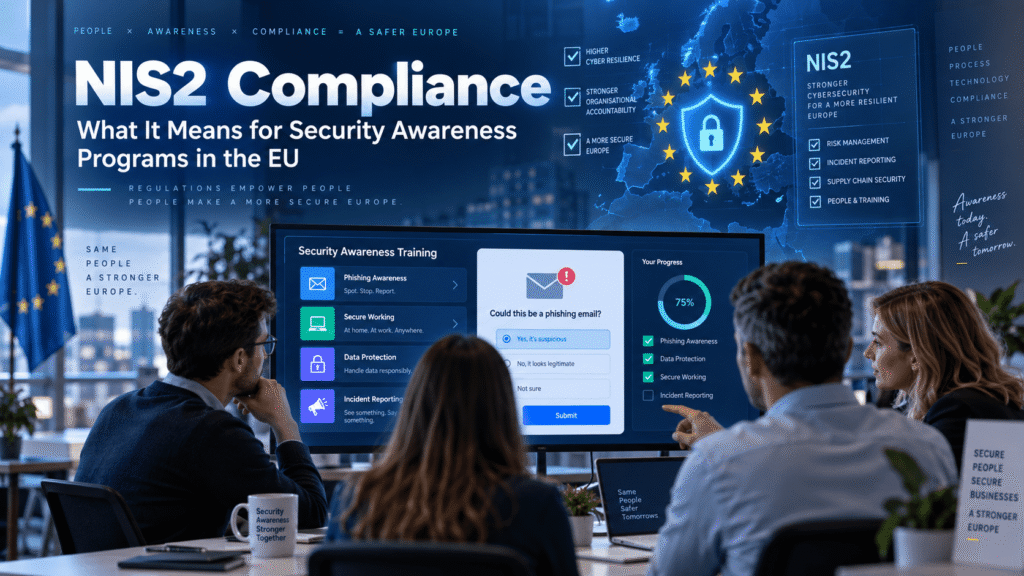
NIS2 Compliance: What It Means for Security Awareness Programs in the EU
If you manage security for a European critical infrastructure organization, the NIS2 Directive isn’t a future concern anymore. It’s here. And if your security awareness program hasn’t been updated to align with its requirements, you’re already behind.
The revised Network and Information Security Directive (NIS2) expanded the regulatory landscape significantly. Unlike its predecessor, NIS2 applies to a much broader set of organizations. It also raised expectations for what “security awareness” actually means in practice.
This post breaks down what NIS2 requires, why it matters for your awareness program, and how to build one that passes regulatory scrutiny.
What Is NIS2?
NIS2 is the EU’s updated cybersecurity directive. It replaces the original NIS Directive from 2016 and entered into force in November 2024. Member states must transpose it into national law by October 2024, with compliance expected across covered organizations by late 2025.
The directive sets baseline security requirements for critical infrastructure operators and essential service providers. It covers sectors like energy, transport, water, healthcare, and digital infrastructure. But NIS2 also extends to cloud service providers, data center operators, and managed service providers.
Unlike NIS1, which was largely prescriptive about specific controls, NIS2 takes a risk-based approach. Organizations must implement measures appropriate to their risk level. This flexibility sounds good until you realize it means you must justify every control decision.
Security awareness training sits at the center of this framework. NIS2 doesn’t just suggest training. It requires that organizations demonstrate a strong security culture and ensure staff at all levels understand their role in protecting critical systems.
Who Needs to Comply?
The scope expansion is where many organizations get surprised. NIS2 applies to critical infrastructure operators and essential service providers in sectors the EU designates as critical. The list includes obvious players like power grids and hospitals.
But NIS2 also covers digital service providers. That means cloud platforms, DNS providers, hosting services, and content delivery networks fall under the directive. If you operate a significant service that European users depend on, you’re likely in scope.
Essential service operators in the following sectors must comply: energy, transport, water and waste management, health, digital infrastructure, and public administration. Some sectors have expanded definitions, bringing in more organizations than NIS1 covered.
Medium and large organizations are also affected. NIS2 defines “large” enterprises differently than GDPR. The threshold is lower, which means more mid-market companies now face compliance obligations.
The directive applies to organizations within the EU, but it extends to non-EU providers serving EU customers. If you have EU operations, you need to comply with NIS2 requirements, including security awareness.
Why NIS2 Changed the Game for Security Awareness
NIS2 marks a shift in how regulators view security culture. They’re no longer satisfied with checkbox training. They want evidence that organizations have built programs where security thinking is embedded into daily operations.
This reflects a genuine change in how breaches happen. Technical controls catch some attacks. Organizational culture, shared responsibility, and employee vigilance catch the rest. Regulators noticed this gap and wrote NIS2 accordingly.
The directive expects that staff understand their role in security. It’s not just IT’s job. Finance teams need to spot unusual transactions. Facilities staff need to notice unauthorized physical access. HR needs to vet contractor backgrounds properly. Every function has a security dimension, and NIS2 requires that people know it.
NIS2 also ties awareness to incident response. Organizations must ensure that employees know how to report suspected incidents. If a phishing email gets through, someone needs to recognize it and escalate quickly. That recognition comes from effective awareness training.
The compliance expectation is continuous, not annual. A single training course each year no longer cuts it. NIS2 expects ongoing reinforcement, periodic refreshers, and evidence that organizations measure awareness over time.
Security Awareness Obligations Under NIS2
The directive includes specific language on security awareness. Article 18 requires that covered entities ensure staff at all levels receive appropriate training to recognize and respond to threats.
Training must address the organization’s actual risk profile. A critical infrastructure operator that manages power distribution faces different threats than a SaaS provider. Your awareness program should reflect your specific threat landscape.
NIS2 also requires training on incident reporting. Staff need to know who to contact when they spot a security problem. They need to understand that reporting suspected incidents is encouraged, not punished.
The directive mentions testing awareness through measures like simulated phishing attacks. This language appears in recitals, not binding articles, but it signals regulatory expectation. Demonstrating that you can measure whether people fall for phishing is strong evidence of a mature program.
Training must be documented. You need to show that training happened, who attended, when, and what they learned. You also need evidence that the training was actually effective, not just that people sat through it.
NIS2 expects board-level understanding of cybersecurity. Senior management must receive training appropriate to their role. This typically means training that focuses on strategic risk, not technical controls.
Real-World Impact: The Phishing Example
Consider how NIS2 changes the practical response to phishing. Under NIS1, organizations could document an annual training requirement and call it done. Under NIS2, regulators expect you to demonstrate that phishing attacks actually fail more often than they succeed.
A critical infrastructure organization in Germany conducts a baseline phishing simulation. They find that 22 percent of employees fall for the test. That’s not unusual. Many organizations see click rates in that range initially.
Under NIS2, that finding triggers action. The organization identifies which departments have the highest click rates. They deploy targeted training for those groups. They increase the frequency of simulations, moving from quarterly tests to monthly ones. After six months, click rates drop to 8 percent.
But here’s what NIS2 actually requires: evidence of this improvement. The organization needs to document that they identified the problem, took action, and verified the improvement. They need to show this to their board. They need to be ready to explain it to regulators.
That same organization also experiences a real phishing attack. Someone receives a convincing email that looks like it comes from a vendor. Because the awareness program worked, the employee hesitates. She forwards it to the security team. The security team recognizes it as a sophisticated spear-phishing attack and blocks it before any compromise occurs.
Documentation of this incident, the employee’s correct response, and the successful mitigation now becomes regulatory evidence that the awareness program works.
Building a NIS2-Compliant Awareness Program
Compliance starts with understanding your threat landscape. What attacks are most likely against your organization? For energy operators, consider physical security breaches paired with digital attacks. For cloud providers, consider insider threats and supply chain attacks.
Map these threats to awareness needs. If supply chain attacks are a concern, train procurement staff on vendor vetting. If insider threats are a risk, ensure all staff understand data handling policies and recognize unusual data access requests.
Design training that’s specific to roles. Developers need different training than procurement staff. System administrators need different content than communications teams. Generic training is weaker than role-specific training.
Build a schedule that includes initial onboarding plus ongoing reinforcement. New hires should complete foundational training within their first month. Refresher training should happen at least annually. Additional focused training should address emerging threats or recent organizational changes.
Include practical skills, not just knowledge. People should practice spotting phishing emails. They should understand what to do if they receive a suspicious request for credentials. They should know how to handle sensitive information properly.
Create a reporting mechanism that’s visible and accessible. Make it easy for staff to report suspected incidents. Communicate how reports are handled. Show that reporting suspected breaches leads to investigation and action, not punishment.
Measure effectiveness continuously. Use simulated phishing to see how many people fall for attacks. Track training completion rates. Survey staff to assess their confidence in recognizing threats. Document all of this.
Tie awareness to incident response plans. When incidents happen, activate your reporting and response procedures. Afterward, use the incident as a teaching moment. Did the awareness program help anyone spot the attack? What could have helped them spot it sooner?
The Role of Technology in Awareness Compliance
Technology enables compliance tracking and execution at scale. Learning management systems can track training completion, record dates, and document content delivered. Most modern LMS platforms generate compliance reports automatically.
Simulated phishing platforms let you test awareness and track improvement over time. These tools show which employees fall for attacks, which departments need targeted training, and whether your program reduces click rates over time. Regulators understand and expect this data.
Dark web monitoring services provide another layer. They alert you if your organization’s credentials appear in breached databases or on underground markets. This informs your awareness training. If your credentials have been compromised, staff need to know their accounts might be at risk.
Automated email security tools can flag potentially malicious messages. But even with these tools in place, humans are still the critical layer. That’s why training matters. Technology catches obvious attacks. Trained employees catch sophisticated ones.
Communication platforms can deliver awareness content at scale. Email campaigns, chat integrations, and intranet updates keep security top of mind. The key is consistency without fatigue. Frequent, brief messages often work better than occasional, lengthy ones.
However, technology is a tool, not a solution. The most sophisticated phishing simulation platform won’t improve awareness if the training content is weak. The best LMS platform won’t show compliance if your training is disconnected from actual threats. Technology supports a good program, but it can’t replace one.
Common Pitfalls and How to Avoid Them
The biggest mistake is treating awareness as a box to check. Organizations often pick a vendor, run annual training, and consider themselves compliant. NIS2 demands more. Regulators expect evidence of continuous improvement.
Another common failure is generic training that doesn’t match your threat model. If your organization is critical infrastructure, training on general cybersecurity basics might be a start, but it’s not enough. You need training that addresses your specific risks.
Many organizations neglect role-based training. Everyone receives the same content, regardless of their function. This leads to disengagement. Finance staff don’t relate to training meant for IT. Facilities teams tune out content focused on developers. Effective programs adapt content to roles.
Some organizations run phishing simulations but don’t use the results. They see that 30 percent of people fall for a test and take no action. Under NIS2, this is unacceptable. You must identify the vulnerable population, provide targeted training, and remeasure to show improvement.
Documentation failures are common. An organization might have a strong awareness program in practice, but if they haven’t documented it, they can’t demonstrate compliance. Keep records of training delivery, attendee lists, assessment results, and improvement metrics.
Excluding senior leadership is another pitfall. Board members and senior executives must receive appropriate training. This doesn’t mean they attend the same training as everyone else, but it means they understand cybersecurity risk and their role in governance.
Some organizations also fail to integrate awareness with incident response. If someone reports a suspected incident, what happens? If that process is broken or unclear, people stop reporting. This violates NIS2’s requirement that organizations facilitate incident reporting.
Practical Steps to Build NIS2-Compliant Awareness Programs
Start by conducting a gap analysis. Compare your current awareness program to NIS2 requirements. What’s missing? Is training documented? Do you measure effectiveness? Is training role-specific?
Develop a training curriculum that addresses your threat landscape. Include initial onboarding for new hires. Include annual refresher training for all staff. Include role-specific training for departments handling sensitive systems or data. Include specialized training for management and leadership.
Implement a learning management system if you don’t have one. You need to track who completed training, when, and what they learned. You need to generate reports showing compliance and trend data.
Select a phishing simulation tool. Run a baseline test to establish where your organization stands. Run simulations at least quarterly. After each campaign, identify employees who fell for the test. Provide targeted remedial training. Run another test in four weeks to check improvement.
Establish a clear incident reporting process. Create a security team email address or phone number where staff can report suspected breaches. Communicate this widely. Track all reports and follow up with the reporter. Show that reporting leads to action.
Define training content for each audience. Developers should learn about secure coding practices and common vulnerabilities. Finance teams should learn to recognize social engineering and fraudulent transfer requests. Everyone should learn basic phishing recognition.
Schedule training on a calendar. Don’t leave it to chance. Plan onboarding training for new hires. Schedule refresher training annually. Schedule role-specific training as needed. Block calendar time for managers to ensure their teams attend.
Create communication campaigns to reinforce training between formal sessions. Use email, intranet posts, or chat messages. Keep messages brief. Highlight recent threats or lessons from past incidents. Make security feel like an ongoing conversation, not an annual event.
Document everything. Keep records of training delivery, attendance, assessment results, simulated phishing campaigns, and incident reports. Organize this documentation so you can retrieve it quickly if auditors request it.
Getting Started: A Practical Checklist
Start here if you’re building compliance from scratch.
- Assess your current awareness program against NIS2 requirements
- Document your threat landscape and risk profile
- Develop a training curriculum addressing identified risks
- Design role-specific training modules
- Create leadership training addressing governance and strategic risk
- Select and implement a learning management system
- Select a phishing simulation platform
- Run baseline phishing tests
- Establish an incident reporting process and communicate it widely
- Train your security team on their role in awareness support
- Create a training calendar for the coming year
- Develop communication campaigns to reinforce training
- Plan monthly or quarterly review cycles to assess program effectiveness
- Document all training delivery, attendance, and assessment results
- Prepare reports for your board showing compliance status and trends
This checklist is your foundation. Add to it based on your specific organizational needs and risk profile.
How CruxRoot Supports NIS2 Compliance
CruxRoot is a security awareness platform designed to help organizations meet regulatory requirements like NIS2. The platform combines phishing simulations, gamified training, and dark web monitoring into a single system.
The phishing simulation tool lets you test awareness at scale. Run campaigns, track results, and identify vulnerable employees. The platform automatically assigns remedial training to people who fall for tests, creating a closed loop between assessment and improvement.
Gamified training keeps engagement high. Rather than traditional, linear courses, the platform uses game mechanics to make learning engaging. Employees earn points for completing training and recognizing threats in simulations. This approach maintains awareness over time rather than fading after a single annual training session.
Dark web monitoring watches for your organization’s credentials in breached databases. If your users’ credentials appear, CruxRoot alerts your team. This generates awareness training opportunities. You can tell your staff that their credentials were compromised and that choosing stronger passwords matters.
The platform integrates with learning management systems and generates compliance reports. You can show regulators that your organization conducted training, measured effectiveness, and improved over time. This documentation is critical for demonstrating NIS2 compliance.
CruxRoot also tracks which employees need additional training based on simulation results. Rather than treating all employees equally, you can focus resources on improving awareness where it’s weakest.
Moving Forward
NIS2 compliance isn’t a one-time project. It’s an ongoing program of training, measurement, and improvement. The organizations that win are those that treat awareness as a core business process, not a compliance checkbox.
Start by understanding your specific requirements. NIS2 applies differently to different organizations based on sector and size. Know where you fall in the regulatory landscape.
Build a program that matches your threat model. Phishing might be your biggest risk. Or it might be insider threats. Or supply chain compromise. Your awareness training should address your actual risks.
Measure and improve continuously. Run simulations. Track training completion. Assess knowledge retention. Identify where people struggle and provide targeted support. Document everything.
Most importantly, recognize that your staff are your strongest defense. They see threats that technology misses. They spot unusual requests that automated systems let through. A well-trained, security-aware workforce prevents breaches that otherwise would succeed.
NIS2 codified this insight into law. You’re not building awareness programs just to pass an audit. You’re building them because they work.
Check our latest the blog regarding Gamification in Security Training