

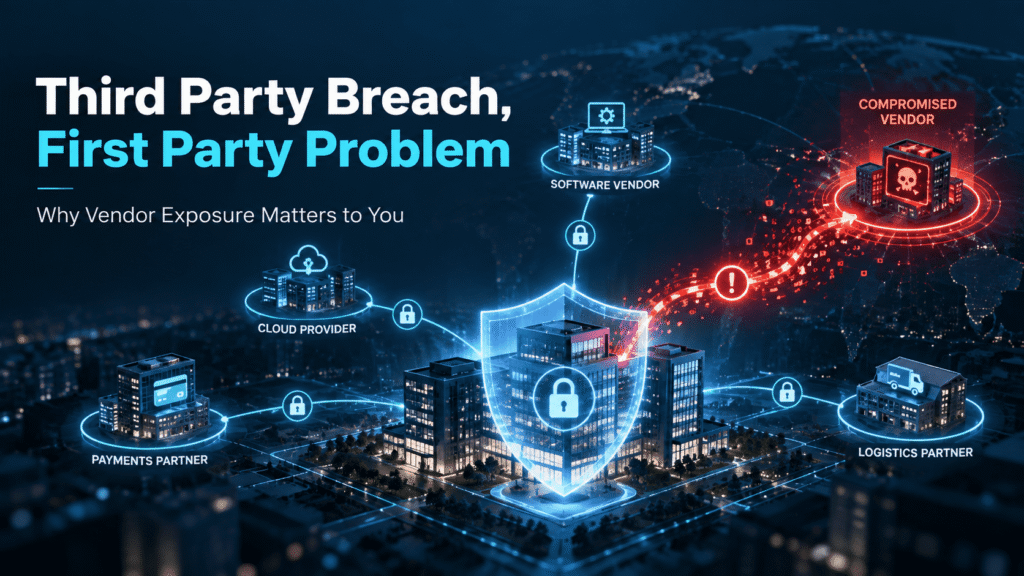
Third Party Breach, First Party Problem: Why Vendor Exposure Matters to You
Your company’s security posture doesn’t end at your firewall. Every vendor, contractor, and service provider who touches your data carries risk you can’t fully control. When a third-party vendor gets breached, your organization inherits the fallout even though you didn’t create the vulnerability.
This isn’t theoretical. It’s the reality security leaders face today.
The problem runs deeper than most teams realize. A vendor breach is a first-party problem because the attackers now have access to your environment, your data, your systems. Your vendor’s weak security becomes your weak security. Your vendor’s negligence becomes your incident.
Understanding this dynamic and building a realistic vendor risk management program isn’t optional anymore. It’s core to keeping your organization secure.
The Scope of Vendor Risk Is Bigger Than You Think
Most organizations have dozens of vendors touching critical systems. Many have hundreds. You probably don’t know the exact number without running an audit.
Each vendor is a potential entry point. Not because vendors are inherently negligent, but because complexity creates blind spots. Your vendors have their own vendors. Your supply chain branches into networks you’ve never mapped.
The attack surface expands with every integration. Every API connection, every data share, every third-party integration is a pathway attackers can exploit. Vendors often have broad access to your systems because they built those systems or maintain them daily. Revoking that access breaks your operations.
Security teams face a hard trade-off. Restrict vendor access and operations suffer. Trust vendor security practices and risk exposure grows. Most organizations lean toward trusting vendors because the operational impact of cutting them off is immediate and measurable, while breach risk feels distant until it materializes.
That calculation has shifted. Third-party breaches are no longer edge-case scenarios. They’re a primary attack vector. Attackers know vendor access is easier to exploit than direct access to your network. They’ve learned that compromising one vendor gives them keys to dozens of customer environments.
Why Third-Party Breaches Hit Different
A breach at your infrastructure host, cloud provider, or critical software vendor isn’t like other breaches. These aren’t just companies that sold you something once. They’re woven into your operational fabric.
Consider what a hosting provider has access to. They manage your servers. They control your infrastructure. They have visibility into traffic, database connections, resource allocation. A breach at the hosting layer is a breach of your entire environment.
The same logic applies to SaaS platforms that handle authentication, identity management, or data storage. Compromising these vendors grants attackers persistence across customer networks. The attacker gains access not just to one customer’s environment but potentially to many.
This is why a third-party vendor breach demands faster response than a standard security incident. You’re not just responding to stolen data. You’re responding to potential unauthorized access to systems critical to your operations.
Attackers understand this leverage. They target vendors not just for the vendor’s data but for access to customer environments. A single compromised vendor relationship can open dozens of customer networks simultaneously.
Your security team can’t prevent your vendor’s breach. You can’t patch their systems or audit their code. You can’t force them to implement better security practices. You can only prepare for the moment when their security fails.
A Realistic Vendor Breach Scenario
Here’s how it actually happens. A mid-market software company that provides billing and customer management services to enterprises gets compromised. The breach starts with credential theft from a contractor who accessed the network using a personal laptop connected to a home WiFi network. The attacker escalates privileges, establishes persistence, and begins moving through the vendor’s environment.
The vendor has security controls. They have firewalls, endpoint detection, logging. But the attacker is subtle and patient. For three weeks, the attacker sits quietly, mapping the network, identifying customer data flows, and understanding what access would be most valuable.
The vendor’s security team doesn’t catch it because their detection tools are configured to flag aggressive behavior. This attacker moves slowly. The vendor’s logging is siloed in ways that prevent full visibility. The pieces of the attack are scattered across multiple systems and the correlation doesn’t happen.
When the breach is finally discovered, it’s by a customer who noticed unusual activity in their own environment. The customer traces the suspicious access back to the vendor’s systems. By that point, the attacker has already copied customer data, established backdoors, and planted payloads that will activate later.
The vendor notifies customers. Now your security team is in crisis response mode. Questions come fast. What data was exposed? What systems were accessed? Did the attacker establish persistence in our environment? How long were they present? What do we do now?
You won’t have clean answers to most of these questions. The vendor won’t either. Their investigation will take weeks. Your response will happen in parallel because you can’t wait for perfect information.
This scenario plays out regularly across industry. Different vendors, same pattern. And every organization affected was secure by their own standards. The breach didn’t happen because of their negligence. It happened because they trusted a vendor who proved less secure than expected.
The Supply Chain Attack Dimension
Third-party vendor risk isn’t limited to direct breaches of vendors you work with. Supply chain attacks are increasingly common, and they follow a specific pattern.
An attacker targets a vendor. That vendor makes a development tool, a software library, a security tool, or an update mechanism that reaches thousands of organizations. The attacker contaminates the vendor’s product or compromises their update mechanism. The tainted update automatically propagates to customers, giving the attacker access to thousands of networks simultaneously.
This approach is efficient. One compromise of a vendor reaches hundreds or thousands of downstream organizations. Each organization that installs the tainted update becomes compromised without knowing it.
Supply chain attacks also bypass many traditional security controls. If the contaminated software comes from a trusted vendor through an expected mechanism, it often passes security checkpoints. Endpoint detection tools sometimes miss compromised software because the signatures aren’t established yet. Network monitoring might not flag traffic from a vendor tool because that traffic is expected.
Security teams can’t always inspect every update, every library, every code dependency. Doing so creates operational drag that slows development and deployment. Organizations make risk calculations about what they can afford to inspect deeply and what they’ll accept with lighter scrutiny.
Attackers exploit those calculation. They target the vendors that have broad reach and lighter scrutiny. A compromise at the right vendor reaches the most networks.
Your Vendor Assessment Program Probably Isn’t Adequate
Most organizations assess vendor risk through questionnaires. You send vendors a security questionnaire. They complete it. You review the responses. Based on the results, you make a decision about whether to work with them.
This approach has value. It screens out vendors with obviously poor security practices. But it also creates a false sense of security. A vendor that completes a questionnaire thoroughly and honestly might still get breached. A vendor with great written security practices might have poor execution.
Questionnaires capture a vendor’s written security posture, not their actual security posture. They measure what a vendor claims to do, not what they actually do. A vendor can have excellent security policies and still implement them poorly.
The best vendor assessment combines multiple inputs. Questionnaires provide a baseline. Independent audits like SOC 2 attestations provide some objective measure. Direct security testing provides real-world validation. Regular reassessment keeps your understanding current because vendor security changes over time.
But even comprehensive assessment doesn’t eliminate risk. You’re managing risk, not eliminating it. A vendor you’ve thoroughly assessed can still be breached by an attacker more sophisticated than their security team expected to face.
Accept this reality: your vendor assessment program’s goal isn’t to ensure vendor security. It’s to understand vendor risk well enough to make informed decisions about how much access to grant them and what data you’ll allow them to touch.
Practical Steps to Manage Vendor Risk
Build a vendor risk management program around three pillars: visibility, assessment, and response.
Visibility starts with knowing which vendors you work with. Create an inventory of vendors that have access to your systems, your data, or both. Include vendors that handle critical functions like hosting, authentication, backup, or billing. Many organizations find they have vendors on this list they forgot about. Discover vendors through your procurement system, through interviews with IT and business teams, and by analyzing your network traffic to identify unexpected outbound connections.
Categorize vendors by risk level. A vendor that has read-only access to non-sensitive data represents different risk than a vendor with root access to production systems. A vendor that has custody of customer data represents different risk than a vendor that simply sends you reports. Use this categorization to prioritize your assessment and monitoring efforts.
Assessment is ongoing, not a one-time event. Require all critical vendors to complete security questionnaires relevant to your industry and their role. For vendors with significant access or sensitive data exposure, require third-party attestations like SOC 2 reports. For vendors in high-risk categories, consider security assessments conducted by your team or external testers.
Establish a reassessment schedule based on risk level. Reassess high-risk vendors annually. Reassess medium-risk vendors every two years. Keep your understanding current because vendor security changes and new threats emerge.
Document security requirements in vendor contracts. Specify requirements for breach notification timelines, incident response cooperation, and audit rights. Make clear that you expect vendors to maintain reasonable security practices and notify you promptly if they’re breached.
Response systems should activate when you learn a vendor has been breached. Establish a process for rapidly determining whether your organization was impacted. Work with the breached vendor to understand the scope of exposure, the timeframe the breach occurred, and what data was accessed.
Decide on containment actions based on the specifics of the breach. If a vendor was compromised, should you immediately revoke their access? That depends on the nature of their access and the availability of backup solutions. Some breaches require immediate action. Others allow for investigation before action.
Create incident response playbooks for vendor breaches so you’re not designing your response as the crisis unfolds. Your security team should understand decision pathways, communication requirements, and escalation procedures before they’re needed.
Detecting When a Vendor Has Been Breached
Your vendor won’t always tell you when they’re breached. Sometimes they don’t realize they’ve been breached. Sometimes they realize it but delay disclosure hoping to minimize customer impact. Sometimes they follow proper notification procedures but it takes weeks.
You can’t rely on vendors alone to tell you they’ve been compromised. Build detection capabilities that alert you to breaches even if the vendor is silent.
Monitor dark web forums where vendors’ credentials and access tokens are traded. If you see credentials belonging to one of your critical vendors being sold, that’s a strong signal of compromise. Knowing this before official disclosure gives you time to prepare response actions.
Monitor for unauthorized access patterns in your own systems that might indicate a breached vendor is being exploited. If a vendor suddenly starts accessing data they don’t normally access, or accessing data at unusual times, that’s worth investigating. The increased access might indicate their credentials have been compromised and are being misused.
Set up automated alerts for when vendors appear in breach databases. Several organizations track breaches across the internet and make this data available through APIs or feeds. If one of your vendors appears in a breach database, you’ll know quickly.
Require vendors to notify you within 24-48 hours of discovering they’ve been breached. Make it explicit that you need notification even if they’re still investigating and don’t yet know the full impact. Early notification gives you a head start on determining whether your environment was affected.
Building a Vendor Risk Culture
Vendor risk management becomes effective when it’s embedded in organizational decision-making, not just security checkboxes.
When your organization considers adopting a new vendor, security should weigh in on that decision from the beginning. Waiting until after procurement has made the decision and negotiated the contract puts security in a reactive position. Pulling a vendor into the security review early gives teams time to establish requirements and get security built into the engagement.
Communicate to your business teams why vendor security matters. Explain that a breach at a critical vendor can grind operations to a halt. Make the business case that time spent assessing vendor security upfront saves massive time and money if that vendor is compromised later.
Create business impact assessments for critical vendors so decision-makers understand what happens if that vendor fails. What systems go offline? What data is exposed? How long can operations continue? This context helps non-security leaders understand why vendor risk management is worth the effort.
Establish single points of contact with critical vendors for security questions. Build relationships with vendor security and incident response teams now, before you need them during a crisis. When a vendor is breached, you want to be able to pick up the phone and reach someone who can help immediately rather than starting vendor relationship-building mid-incident.
Vendor Risk Meets Employee Risk
A third-party vendor breach often succeeds because the vendor’s employees click phishing links, reuse passwords, or fail to secure their laptops. Vendor employees are human and face the same social engineering tactics that target your employees.
This is why security awareness training works at preventing breaches. When vendor employees understand phishing tactics, social engineering, and password security, they’re less likely to inadvertently create the initial compromise that leads to a full vendor breach.
Many organizations now extend security awareness requirements to their vendors. You might require that vendors conduct annual security training for their staff, especially staff with access to customer data or systems. Some organizations require that vendors run phishing simulations to test whether employees recognize social engineering attempts.
These requirements aren’t about micromanaging your vendor’s internal practices. They’re about reducing the probability that vendor negligence creates a breach that spills over into your environment. An engaged vendor team that understands security risks is less likely to create entry points attackers can exploit.
How Cruxroot Helps Address Vendor Risk
Vendor risk management requires multiple tools and approaches working together. One piece of the puzzle is ensuring your own employees understand the risks that vendor compromise creates.
Cruxroot’s phishing simulations and dark web monitoring help you understand and reduce your internal risk. Phishing simulations test whether your employees recognize social engineering attempts, the same tactics used to breach vendors. When your team passes phishing simulations consistently, they’re less likely to be the entry point for attackers targeting your organization or your vendors.
Dark web monitoring keeps you aware of whether your organization or your vendors have been compromised. If your credentials appear for sale on the dark web, you know your security has been compromised and can respond immediately. If your vendor’s credentials appear, you have early warning that their systems may have been breached.
Gamified security training through Cruxroot ensures your team stays engaged with security practices over time. Vendor risk management isn’t a one-time project. It’s ongoing work that requires sustained attention. An engaged team that understands vendor risk as part of their security responsibilities will naturally contribute to better vendor management across your organization.
Final Thoughts
Third-party vendor breach is a first-party problem because vendor security directly impacts your security. You can’t eliminate vendor risk. You can only understand it clearly, assess it realistically, and prepare for the moment when a vendor fails.
Start by building visibility into which vendors touch your systems and data. Assess vendors based on their actual risk to your organization, not generic criteria. Establish detection capabilities so you know when a vendor has been breached. Build response procedures in advance so you’re not making critical decisions in crisis mode.
Make vendor risk a shared responsibility across your organization. Security owns the program, but business leaders, IT teams, and employees all contribute to managing vendor risk effectively. When vendor risk management becomes part of organizational culture, breaches that would have been catastrophic become manageable incidents.
The vendors you trust today might be breached tomorrow. That’s not pessimism. That’s reality. The organizations that handle vendor breaches best are the ones that prepared for that reality in advance.
Check our latest the blog regarding Cyber Insurance Requirements Are Changing: Is Your Training Program Enough?